


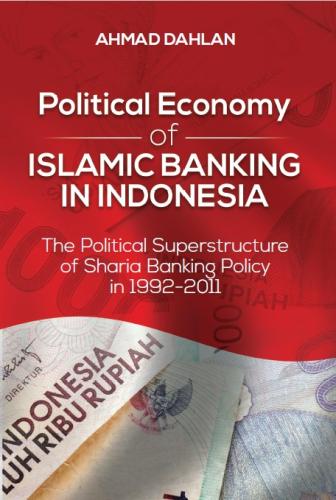
Political Economy of Islamic Banking in Indonesia
Keywords:
Political Economy, Islamic Banking, IndonesiaSynopsis
This book is a work of historical analysis focusing on the development of Islamic financial institutions from 1992 to 2011 in Indonesia as they relate to Islamic banking using a political-economic approach. Indonesia plays an influential role in various international political and Islamic organizations because it has the largest Muslim population in the world. Although Indonesia was late in establishing its banking initiatives, it did so 1992 in response to the growth of the Islamic financial institutions. From 1992 to 2011 many laws and regulations were established to support the growth of Islamic banking in Indonesia, but by national financial market indicators, Islamic banking in Indonesia fell behind many expectations. This analysis suggests that the shortcomings may be due in part to the waning power of key elements of the political superstructure to push policies that supported Islamic banking and Islamic economic systems and establish synergies with institutions of Islamic economic education and stakeholders to accelerate the growth of Islamic banks in terms of service, national market share, and public trust.
References
Adewale, A.A. and Archer, S. (2019). “Risk Sharing in Islamic Banking,”IFSB Working Paper Series Technical and Research Department, WP-10/05/2019, May.
Ahmad, W. (2008). Islamic Banking in the United Kingdom: Opportunities and Challenges. Kingston Business School, London. https://www.alislam.org/library/articles/Islamic-Banking-in-the-UK.pdf
Ahmed, G. F. (2008). “The implication of using profit and loss sharing modes of finance in the banking system, with a particular reference to equity participation (partnership) method in Sudan,” Humanomics, 24 (3): 182–206. https://doi.org/.liverpool.idm.oclc.org/10.1108/08288660810899359
Ahmed, M. M., Farooq, M., and Arsalan, M. (2016). “Running Musharakah Product of Islamic Banks: An Alternative of Running Finance,” Al-Idah, 33, Dec.
Ali, M. (2004). “Islam and Economic Development in New Order’s Indonesia (1967–1998),” Paper, presented ion the 3rd East-West Center International Graduate Student Conference, Honolulu, Hawaii, USA, February 19–21. International Graduate Conference Series/East-West Center Paper Series (12).
al-KâsânÎ, A. B. (2000). Badâ’i’ al-Sanâ’i fî Tartîb al-Sharî’y (Dâr Ihyâ’ al-Turâth al-‘Arabîy, Beirut).
Amadeo, K. (2020). “Deregulation Pros, Cons, and Examples,”.” The balance, October 16.
Angel J. R. (1970). “The ‘New Emerging Forces’ In Indonesian Foreign Policy,” Thesis of Doctor of Philosophy in the Australian National University, February, Vol. II.
Anugrah, I. (2011). “Political Parties and Religious Local Ordinances in Post-Soeharto Indonesia,” Thesis (Ritsumeikan Asia Pasifik University, Kyoto).
Argenti, G. and Dias, D., S., I. (2018). “Soekarno’s Political Thinking About Guided Democracy,” Jurnal Politikom Indonesiana, 3 (2): 46–63.
Ariff, M. (1998). “Islamic Banking,” Asian-Pacific Economic Literature, 2 (2): 48–64. https://doi.org/10.1111/j.1467-8411.1988.tb00200.x
Arifin, M. & Nasution, B. (2015). “The Dynamics Study of Regulations on Syariah Banking Indonesia,” International Journal of Humanities and Social Science, 5 (3): 237–242.
Arshad, N. C. and Ismail, A.G. (2010). “Shariah parameters for Musharakah Contract: A comment,” International Journal of Business and Social Science, 1 (1): 145–162.
Askari, et al. (2015). Introduction to Islamic Economics; Theory and Application (John Wiley & Sons Singapore Pte. Ltd.: Singapore).
Ayubi, N.N. (1991). Political Islam; Religion and Politics in the Arab World (Routledge, London and New York).
Bani Salamah, M (2017). “The World Bank and International Monetary Fund as Mechanisms of Western Domination: Historical and Contemporary Analysis”,” The Arab Journal For Arts, 14 (2): 923–944.
Boland, B.J. (1982). the Struggle of Islam in Modern Indonesia (Martinus Nijhoff, The Hague).
Belouafi, A. & Chachi, A. (2014). “Islamic Finance in the United Kingdom: Factors Behind its Development and Growth,” Islamic Economic Studies, 22(1): 37–78. DOI: 10.12816/0004130
Bertrand, J. (2004). Nationalism and Ethnic Conflict in Indonesia (Cambridge University Press, Cambridge).
Bergman, T., Müller, W.C., Strøm, K. (2000). “Introduction: Parliamentary Democracy and the Chain of Delegation,” European Journal of Political Research 37: 255–260.
Binder, L. (1988). Islamic Liberalism: A Critique of Development Ideologies (University of Chicago Press, Chicago, London).
Blöndal, J. R., Hawkesworth, I. and Choi, H.D. (2009). “Budgeting in Indonesia”, OECD Journal on Budgeting, Vol. 2009/2: 1–31. https://www.oecd.org/gov/budgeting/45362389.pdf
Bresnan, J. (1993). Managing Indonesia, the Modern Political Economy (Columbia University Press, New York).
Budiman, A. (ed.). (1990). State and Civil Society in Indonesia (Center of Southeast Asian Studies, Monash University, Monash).
Butterworth, C.E., and Zartman, I.W. (1992). Political Islam, the Annuals of the American Academy of Political and Social Science, November.
Caporaso, J.A., and Levine, D.P. (1992). Theories of Political Economy (Cambridge University Press, Cambridge).
Chapra, M.U. (1992). Islam and the Economic Challenge (The Islamic Foundation and IIIT, Leicester).
Chapra, M.U. (2001). The Future of Economics: An Islamic Perspective, transl. Amdiar Amir, et al. (SEBI, Jakarta).
Chapra, M.U. (2005). Islam and Economic Development, transl. Ikhwan Abidin Basri (Gema Insani Press, Jakarta).
Croissant, A. and Ebert-Stiftung, F. (eds). (2002). Electoral Politics in Southeast and East Asia: 75–99 (Office for Regional Co-operation in Southeast Asia, Singapore).
Dâbȗ, I.F. (1997). ‘Aqd al-Mudâraba Dirâsat fî al-Iqtisâd al-Islâmî (Dâr‘Amar, ‘Amman).
Demiralp, S. & Demiralp, S. (2004). “The Rational Islamic Law Or? Evidence from Islamic Banking,” KOÇ University-Tüsiad Economic Research Forum Working Paper Series, December, Working Paper 1425: 1–36.
Ebrahim, M.S. & Joo, T.K. (2001). “Islamic Banking in Brunei Darussalam,” International Journal of Social Economics, 28 (4): 314-337. https://doi.org/10.1108/03068290110357708
El Hussein, N. H. A. (2018). “The Sharia Supervisory Board: Does it Influence Corporate Social Responsibility Disclosure by Islamic Banks? A Review,” Journal of Islamic Studies and Culture, 6 (1): 121–132. DOI: 10.15640/jisc.v6n1a13.
Ekatjahjana, W., Heilmann, D. and Hauerstein, K. (2002). Regulatory Reform in Indonesia A Legal Perspective (Hanns Seidel Foundation,
Jerman).
Engzell, C. (2008). “Islamic Banks in the United Kingdom: Growth in the 21st Century,” Methods in Economic History and Research
Paper: 1–29. Uppsala University, Department of Economic History. (http://www.diva-portal.org/smash/get/diva2:134517/FULLTEXT01.pdf)
Fakih, F. (2013). “Institutional Reforms of the Guided Democracy (1957-1965),” Lembaran Sejarah, 10 (1): 96–113.
Fossati, D. (2019). “The Resurgence of Ideology in Indonesia: Political Islam, Aliran and Political Behaviour,” Journal of Current Southeast Asian Affairs, 38 (2): 1–31. https://doi.org/10.1177/1868103419868400
Geertz, C. (1976). The Religion of Java (University of Chicago Press, Chicago).
Gold, J. (1980). The Role of Law in the International Monetary Fund (IMF, Washington).
Goldstein, J. (1993). Ideas, Interest, and American Trade Policy (Cornell University Press, Ithaca, and London).
Gordon, J. (1998). “NGOs, the Environment and Political Pluralism in New Order Indonesia,” Explorations in Southeast Asian Studies, 2 (2): 1–26. https://core.ac.uk/download/pdf/5094842.pdf
Gorner, B.A. (2004). The Black’s Law Dictionary (Thomson Business, St. Paul, MN).
Guex, S. (2000). “The origins of the Swiss law on banking secrecy and its repercussions for Swiss Federal policy,” A Review of The History
of The Business 74 (Summer 2000): 237–266.
Hadiz, V.R. (2008). “Towards a Sociological Understanding of Islamic Radi- calism in Indonesia,” Journal of Contemporary Asia, 38 (4): 638–47.
Hadiz, V.R. (2011). “Indonesian Political Islam: Capitalist Development and the Legacies of the Cold War,” Journal of Current Southeast Asian Affairs, 30 (1): 3–38. DOI: 10.1177/186810341103000101
Hakam, S. (2017). “The in Terpretation of the First Verse [Ketuhanan Yang Maha Esa] of Pancasila,” JIA, 18 (1): 1–9. DOI: https://doi.org/10.19109/jia.v18i1.1531
Hallward-Driemeier, M., et al. (2020). “Does Democratization Promote Competition? Evidence from Indonesia,” Policy Research Working Paper 9112: 1–72.
Hamat, Z., Sari, M. D., Bahari, Z. (2016). “History of Islamic Bank in Indonesia: Issues Behind Its Establishment,” International Journal of Finance and Banking Research, 2 (5): 178–184. DOI: 10.11648/j.ijfbr.20160205.13
Hanif, M. (2011). “Differences and Similarities in Islamic and Conventional Banking,” International Journal of Business and Social Science, 2 (2): 166–175.
Hefner, R. W. (2000). Civil Islam: Muslims and Democratization in Indonesia (Princeton University Press, UK).
Hefner, R.W. (2001). “Public Islam and the Problem of Democratization,” Sociology of Religion, 62 (4): 491–514. https://doi.org/10.2307/3712438
Henry, C.M., and Wilson, R. (eds.) (2004). The Politics of Islamic Finance (Edinburgh University Press, Edinburgh).
Henry, C.W. (2015). “Islamic Finance in Indonesia: High Tide or New Mecca?” Middle East Institute, National University of Singapore. https://pdfs.semanticscholar.org/d77b/1678529222a96d8ec4cebaf39e498a6d1064.pdf
Heywood, A. (2002). Politics (Palgrave Macmillan, New York).
Hidayat, S. (2010). “Moderation and the stagnation of the PKS in the 2009 legislative election”, LSE IDEAS Reports, London School of Economics, May. http://lse.ac.uk/IDEAS/publications/reports/pdf/SR005/IndoHidayat.pdf
Hughes, E.K., Gullone, E. (2010). “Reciprocal Relationships Between Parent and Adolescent Internalizing Symptoms.” Journal of Family Psychology, 24 (2): 115–24.
Ibn, Qudâmah, A. (n.d). Al-Mughnî (Dâr al-Kirâb al-‘Arabîy, Beirut).
Ibn, Taimiyyah. (1966). al-Siyâsah al-Shar’iyyah (Dâr al-Kitâb al-’Arabiyah, Beirut).
Ibrahim, A.B. and Noor, A. B. (2011). “The Application of Wadi‘ah Contract by Some Financial Institutions in Malaysia,” International Journal of Business and Social Science, 2 (3): 255–264.
IDB. (2013). Islamic Development Bank Group, Islamic Development Bank Group In Brief, Booklet, Jumad-il-Akhir, 1434H, May.
Idris, M. (2017). “Bank Secrecy: An Overview on The Rule of Sharia Banking Law In Indonesia,” Jurnal Komunikasi Hukum, 3 (2): 52–68. DOI: http://dx.doi.org/10.23887/jkh.v3i2.11824
ICTJ (n.d). “Institutional Reform,” https://www.ictj.org/our-work/transitional-justice-issues/institutional-reform.
IMF. (1986). “Fund Supported Programmes, Fiscal Policy, and Income Distribution,” IMF Occasional Paper, September (46).
Indrastomo, B.S. (2016). “The Emergence of Islamic Economic Movement in Indonesia: A Political Economy Approach,” Kyoto
Bulletin of Islamic Area Studies, 9, March.
Iqbal, M. (ed.) (2002). Islamic Economic Institutions and the Elimination of Poverty (Leicester: Islamic Found at Serageldin, Leicester, UK).
Iskandar, S. (2002). “Financial Deregulation and Demand for Money In Indonesia”, Buletin Ekonomi Moneter dan Perbankan, June. https://core.ac.uk/download/pdf/234038784.pdf
Islamic Bank of Britain. Annual Reports & Financial Statements 2005–2007.
Javaid, O. (2015). “Inderscience Enterprises Ltd. The Original Sociocultural and Economic Context for Practicing Shirkat-ul-Aqd,” Int. J. Pluralism and Economics Education, 6 (4): 371–385.
Johnson, K. (2013). “The Role of Islamic Banking in Economic Growth,” CMC Senior Theses, Paper 642, Claremont McKenna College. (http://scholarship.claremont.edu/ cmc_theses/642).
Kasiyanto, S. (2017). “Central Bank Transparency in Indonesia: A Law and Economic Perspective,” Indonesia Law Review, 2: 178–207. DOI: http://dx.doi.org/10.15742/ilrev.v7n2.320
Kawamura, K. (2008). “Indonesia’s Development Policy in Historical Perspective”, Japan International Cooperation Agency (JICA),
JICA-IDE Joint Workshop on Indonesia’s Development Strategy and Future Direction of JICA’s Assistance in Indonesia, Background Paper No. 2.
Utama, N.A. (eds.). (2013). Procedia Environmental Science, Vol. 17, the 3rd International Conference on Sustainable Future for Human
Security, November, Clock Tower Centennial Hall, Kyoto University, Japan.
Vaillant, G. G. (2012). Authoritarian Regimes, Wiley online Library, 29 February 29. https://doi.org/10.1002/9780470670590.wbeog038
van Greuning, H. and Iqbal, Z. (2008). Risk Analysis for Islamic Banks (The International Bank for Reconstruction and Development/The World Bank, Washington).
Weber, E. (2015). “Populism as a Constant Companion of Democracy Empirical Evidence from Switzerland between 1947 and 2011,” paper prepared for the ECPR General Conference, Montreal, August 26–29.
Wie, T.K. (ed.) (2003). Recollections: the Indonesian economy, 1950s–1990s (Institute of Southeast Asian Studies, Singapore).
Wilson, R. (2007). “Islamic Finance in Europe,” RSCAS Policy Papers, European University Institute, 2. (http://www.eui.eu)
Winters, J. (1996). Power in Motion (Cornell University Press, New York, Ithaca).
Woischnik, J. and Müller, P. (2013). “Islamic Parties and Democracy In Indonesia Insights From The World’s Largest Muslim
Country,” KAS International Reports 10. https://www.kas.de/c/document_library/get_ file?uuid=0926cd78-a45d-5a57-7c4be776f8de78c2&
groupId=252038
Wolf, M. (1981). Elusive Development (United Nations Research Institute for Social Development, Hungary).
Zarkasyi, H.F. (2008). “The Rise of Islamic Religious-Political Movements in Indonesia, The Background, Present Situation and Future,” Journal of Indonesian Islam, 2 (2): 336–378.
Zarqâ’, M.A. (1967). al-Madkhal al-Fiqh al-’Âm (Dâr al-Fikr, Damaskus).
Zurbuchen, M.S. (2002). “History, Memory, And The “1965 Incident” In Indonesia,” Asian Survey, 42 (4): 564–582.
Published
October 3, 2021
Categories
Copyright (c) 2021 Ahmad Dahlan
Details about the available publication format: PDF
PDF
Co-publisher's ISBN-13 (24)
9781627342957
Details about the available publication format: Paperback
Paperback
Co-publisher's ISBN-13 (24)
9781627342940